![Logo_Trinnov_Black_CMJN.png]](https://kb.trinnov.com/hs-fs/hubfs/ISE%202024/Logo_Trinnov_Black_CMJN.png?height=50&name=Logo_Trinnov_Black_CMJN.png)
Summary:
Overview
The Trinnov 3D Measurement Microphone is the dedicated hardware device used by all Trinnov processors during system calibration. Its four-capsule layout allows the processor to capture the acoustic information needed for accurate speaker localization and room response analysis.
This article provides a hardware-only overview of the microphone, its design, versions, and compatibility across the Trinnov range. For calibration steps or placement guidelines, refer to the dedicated setup and calibration articles.
Physical Design
4-Capsule Geometry
The Trinnov 3D Microphone features four microphone capsules arranged in a precise tetrahedral configuration. This fixed geometry allows the processor to identify differences in arrival time and direction between capsules during calibration.
Construction
- Rigid metal body
- Integrated mount compatible with standard microphone stands
- Supplied in a protective case (contents may vary depending on product version)
Included accessories
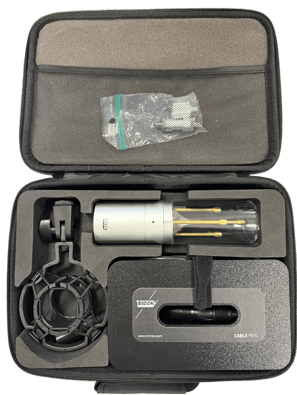
Every 3D Microphone is delivered in a dedicated protective case containing:
- 1 × 3D Microphone (V9 or Ethercon, depending on your processor)
- 1 × 10m microphone cable, supplied with a cable reel inside the case to neatly wind and store the cable
- 1 × suspension mount
- 1 × thread adapter
Versions & Connectors
Note: The different microphone versions (XLR5 and EtherCon) deliver exactly the same acoustic measurement performance and localization accuracy. The only difference lies in the workflow.
5-pin XLR Version (V9 and earlier)
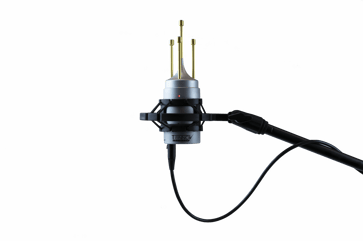
This version uses a 5-pin mini-XLR connector and is compatible with all Trinnov processors released before 2023.
It includes a detachable microphone cable, available with either:
- a single 5-pin XLR connector on the processor side (Altitude32 & Altitude16), or
- four 3-pin XLR connectors for use with legacy multi-channel microphone inputs (Amethyst & Altitude32).
The microphone is powered by its built-in 9V battery and must be manually switched on and off during calibration.
Caution: the XLR5 microphone is delivered with a USB stick containing its individual compensation file, which must be manually loaded into the processor before use.
Warning: The four 3-pin XLR connectors must be connected in the exact numerical order of the cables (XLR 1 to input 1, XLR 2 to input 2, etc.). Any mismatch will result in inaccurate 3D localisation.
EtherCon Version (V10)
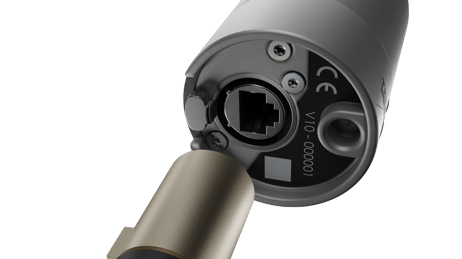
The latest version of the Trinnov 3D Microphone uses a locking EtherCon connector.
It is powered directly by the processor, which also controls its on/off state through the dedicated EtherCon port of compatible units.
This version stores its calibration compensation file internally. The file is automatically transferred to the processor during the calibration process, no manual loading is required.
This version cannot be used with legacy 5-pin XLR microphone inputs.
Note: The two microphone versions are not interchangeable.
Compatibility
The table below shows which microphone version is required for each Trinnov processor:
|
Processor |
Compatible Microphone Version |
|
Altitude32 |
5-pin XLR, 4x XLR3 |
|
Altitude16 |
5-pin XLR |
|
NOVA |
EtherCon version only |
|
AltitudeCI |
EtherCon version only |
Technical Specifications
- Capsules: 4
- Geometry: Tetrahedral
- Connectors: 5-pin XLR or EtherCon (depending on version)
- Power: Supplied by the processor
- Mounting: Standard microphone stand thread
- Body: Metal construction
- Frequency Response: +/-0,1dB from 20Hz to 24kHz
- Localization Precision: +/-2* precision both horizontally and vertically
- Distance Measurement Precision: +/-1 cm
- Absolute Level Measurement: Yes
More information and specifications on our website.